
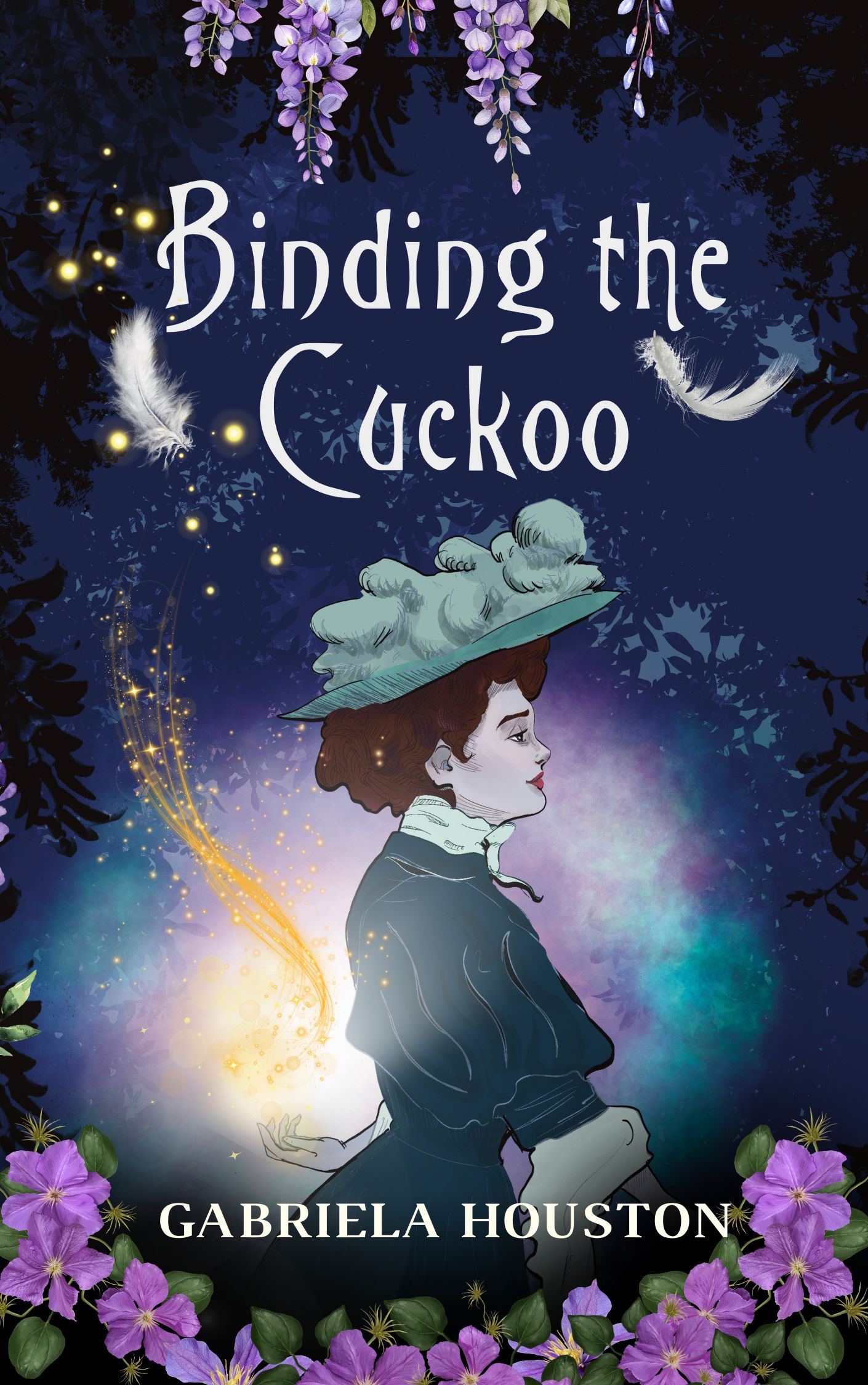
Last month, I promised that I’d share a little about my experience judging this year’s British Fantasy Award for Best Independent Press. I also have a review for an enchanting new romantasy novel, so let’s start with that, and I’ll say more about judging later.
Binding the Cuckoo Review
Binding the Cuckoo is the first foray into independent publishing from Gabriela Houston, author of The Bone Roots and several other novels rooted in Slavic mythology. Well, perhaps it counts as the second, since I got to know Gabriela as the editor for the Kickstarter-backed, beautifully illustrated anthology Whispers in the Earth: World Folklore Reimagined, to which I contributed a Canadian ghost ship story.
Gabriela kindly sent me a review copy of Binding the Cuckoo. As a fan of her previous work, I was excited to see what her historical fantasy romance had in store.
Here’s the blurb:
1899: A fay grifter seeks fortune and security.
Love was never the plan.
In the late Victorian era, a technological marvel allows scientists to open rifts into the realms of legend. Powerful creatures, weakened and stripped of their memories, are brought to serve the whims of the wealthy elite…
Hare, a young woman with a mythical secret finds herself trapped, facing an unenviable future.
When an equally desperate schoolmistress, Miss Anne Bonningham offers her a chance at freedom, they embark on a daring plan. Disguised as “Miss Edwina Walker,” Hare navigates the treacherous waters of London high society, solely focused on securing a marriage and escaping her past.
However, amidst the glittering balls and intricate social games, as hidden agendas surface and a vengeful figure from her past threatens to expose her true identity, Hare must make a choice: embrace a life of comfort and security or choose freedom and a love that could shatter the very foundation of her world.
If you like your fantasy light, but heavy on the sexual tension, this one’s for you. Hare is an outsider protagonist with few options, and I sympathized with her right away.
In the alternate history, “mythics” are otherworldly beings (mostly fairies) brought into our world, where their magic weakens and memories fade, to serve humans. Hare was betrayed by someone she trusted, and has little idea of who she was before. When offered freedom through an alliance with a somewhat unsavory character, there’s little else she can do.
So, we’re off to London, where Hare poses as Miss Anne Bonningham’s American relative seeking a match. If she can secure a good marriage, both she and her “matchmaker” will have their currently dire futures secured.
Cue the high-society socializing, the kind (if a bit silly and arrogant) duke who takes a shine to Hare, and his lawyer friend who clashes with her again and again, with sparks flying. You could call it a love triangle, but where one option represents security and the other a deeper connection, it’s pretty clear how things are going to turn out. The fun is in getting there.
Along the way, we encounter a variety of mythics who can’t pass as human like Hare can, and struggle to get work. Their interactions are nuanced, as they can magically recognize each other but humans can’t recognize them in the same way. I’d love to know more about them and their world, which is only lightly sketched out. Maybe in a future book?
Binding the Cuckoo is an easy, elegant read. It comes out on October 15, and you can pre-order it now.
Literary Judging: What’s It Really Like?
Any writer reading this is probably intimately familiar with the process of being judged. You sent a piece or pitch to a publication, or a manuscript to an editor or publisher, you wait, and most of the time, you get another rejection letter to add to your growing collection.
I’ve been on both sides of the desk. Along with writing, I used to edit and read submissions for literary magazines. Several years ago, I sat on a panel judging a magazine grant for a Canadian province I’ve never lived in. And this year, I was one of five judges for the British Fantasy Award for Best Independent Press.
The winners of this year’s British Fantasy Awards will be announced at the World Fantasy Convention in Brighton, which takes place from October 30-November 2. So I won’t be sharing any spoilers here, but I have some insights into the process of judging a literary award.
How do you judge something as subjective as the quality of written work? You start by assembling a panel of judges, who all bring different experiences and opinions. Our group had some degree of consensus around quality, strengths, and weaknesses after reading the material – and it was a lot of material. I read a sample of books from each press, for a total of (I think) 20, and there are more in a box if I want to dive into them later.
Some judging panels agree on criteria and give scores to the material. With others, it’s a more fluid discussion – more of an art than a science.
Both panels I’ve been on have been very respectful groups. I imagine the rest of the British Fantasy Awards were similar, with thoughtful, generous debates and discussions of each work’s respective merits. There were differences of opinion, but everyone had fair input. It came down to a nail-biter, and I got to be the deciding vote.
What I witnessed from award judging was just how many good books, publishers, and works might not win awards, but offer high quality, unique perspectives, and valuable contributions to their genres. That’s something I found when reading submissions for magazines, as well. There’s so much good stuff out there! There aren’t spaces or awards for all of it, and not being “chosen” doesn’t make a work any less worthy.
Someone else winning an award, or a rejection of your story, is not a rejection of you.
Some people like to imagine rivalries in the writing world. Maybe they exist, but that hasn’t been my experience. With speculative fiction especially, I see a bunch of geeks getting excited over each other’s books. With publishing more broadly, when one book does well, that can create space for others, and excited readers are more likely to read something else.
There are unkind people and poor behavior in every industry. But my experience judging an award was one of respect and collegiality. From what I’ve seen, the future of independent publishing in British SFF looks hopeful.
Leave a Reply
You must be logged in to post a comment.